Forma.
Hiring intelligence, built on evidence.
An AI-powered recruitment platform that evaluates candidate relevance beyond keyword matching through semantic search, structured skill matching and explainable scoring.
Visit Live Website — Forma. (opens in a new tab)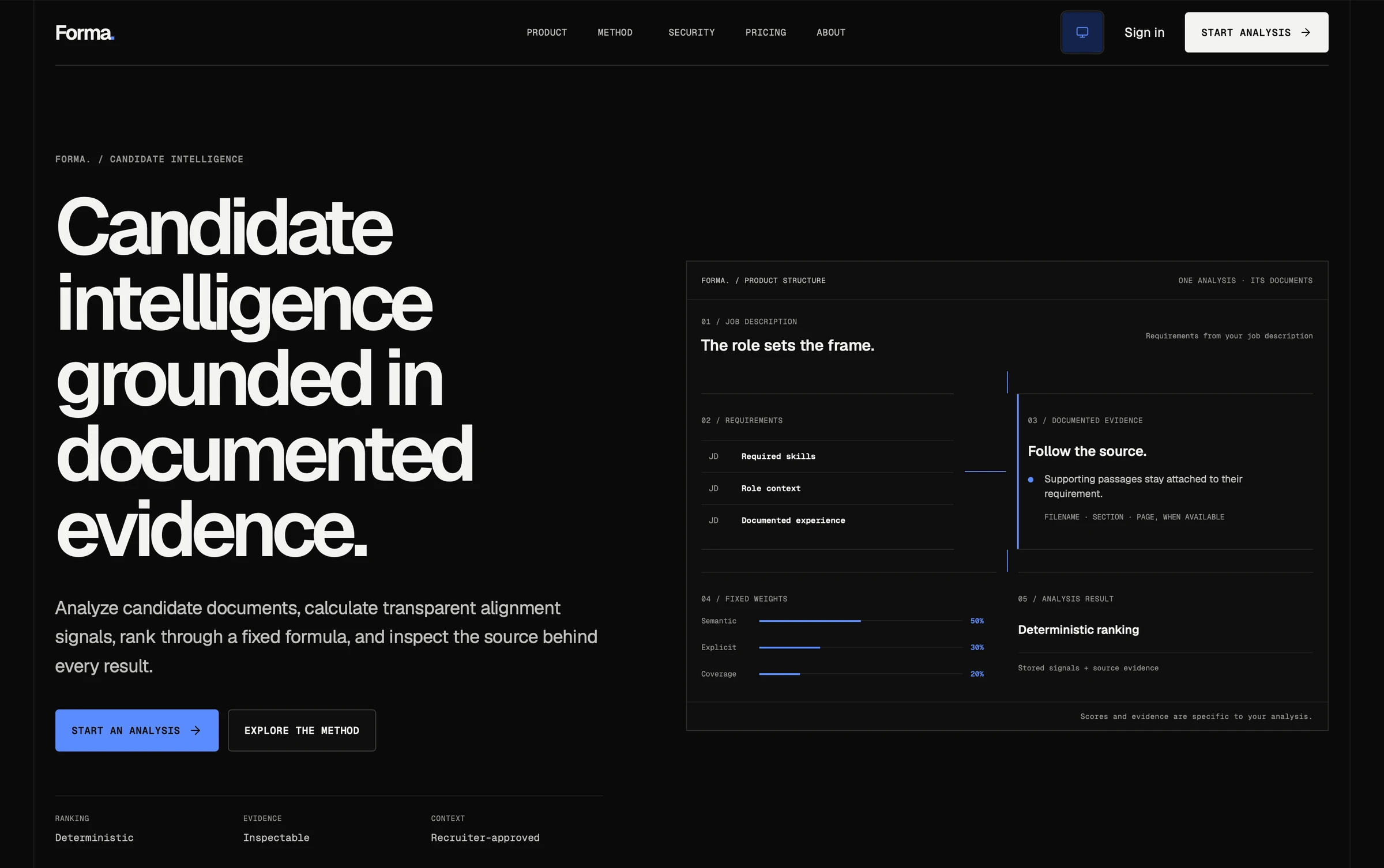
- Full-Stack Developer · AI Integration · Product Engineering
- Next.js / PostgreSQL / pgvector / OpenAI
- Semantic search / Evidence-grounded scoring
The evaluation method
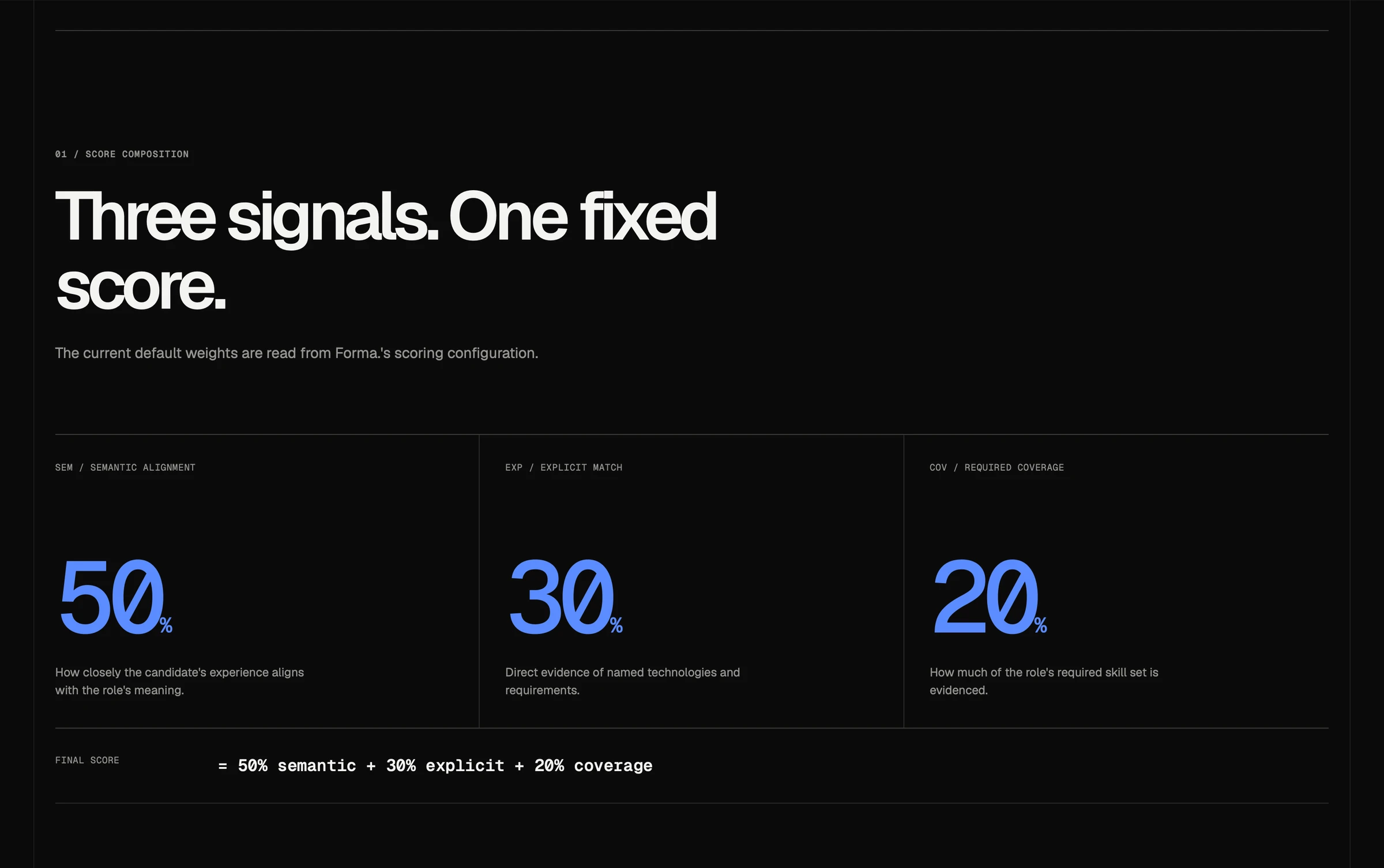
- 50%
How experience relates to the meaning of a role.
- 30%
Direct evidence of the named requirements.
- 20%
How much of the required skill set is evidenced.
Semantic alignment contributes 50% of the composite score. It relates the candidate’s experience to the meaning of the role.
Method weights, not candidate results. Evidence remains attached to the requirements it supports.
A ranking should explain itself.
An AI-powered candidate intelligence platform that ranks resumes against job requirements using semantic similarity, explicit skill matching and evidence-backed analysis.
The problem
A keyword match can identify a named skill, but it does not explain how a candidate’s experience relates to a role. Forma brings semantic alignment, explicit matches and documented evidence into the same evaluation.
What I built
I built the full-stack product and integrated AI-assisted analysis, semantic search and authentication around a transparent candidate-scoring method.
Three signals. One fixed score.
The method makes the weighting visible. Semantic alignment contributes 50%, explicit matching 30% and required-skill coverage 20%. Evidence stays attached to the requirements it supports, so a result can be inspected beyond its rank.
Semantic alignment
Compare experience with the meaning of the role, beyond exact terms.
Explicit matching
Identify direct evidence of named technologies and requirements.
Required coverage
Show how much of the required skill set is evidenced in candidate documents.
Search, evidence and identity.
The implementation combines a Next.js interface with PostgreSQL and pgvector, an OpenAI integration, Supabase Auth and Cloudflare R2.
- 01Interface
- Next.js / React / TypeScript / Tailwind CSS
- 02Intelligence
- OpenAI API / semantic search / pgvector
- 03Data & access
- Supabase / PostgreSQL / Supabase Auth / Cloudflare R2
- 04Delivery
- Vercel
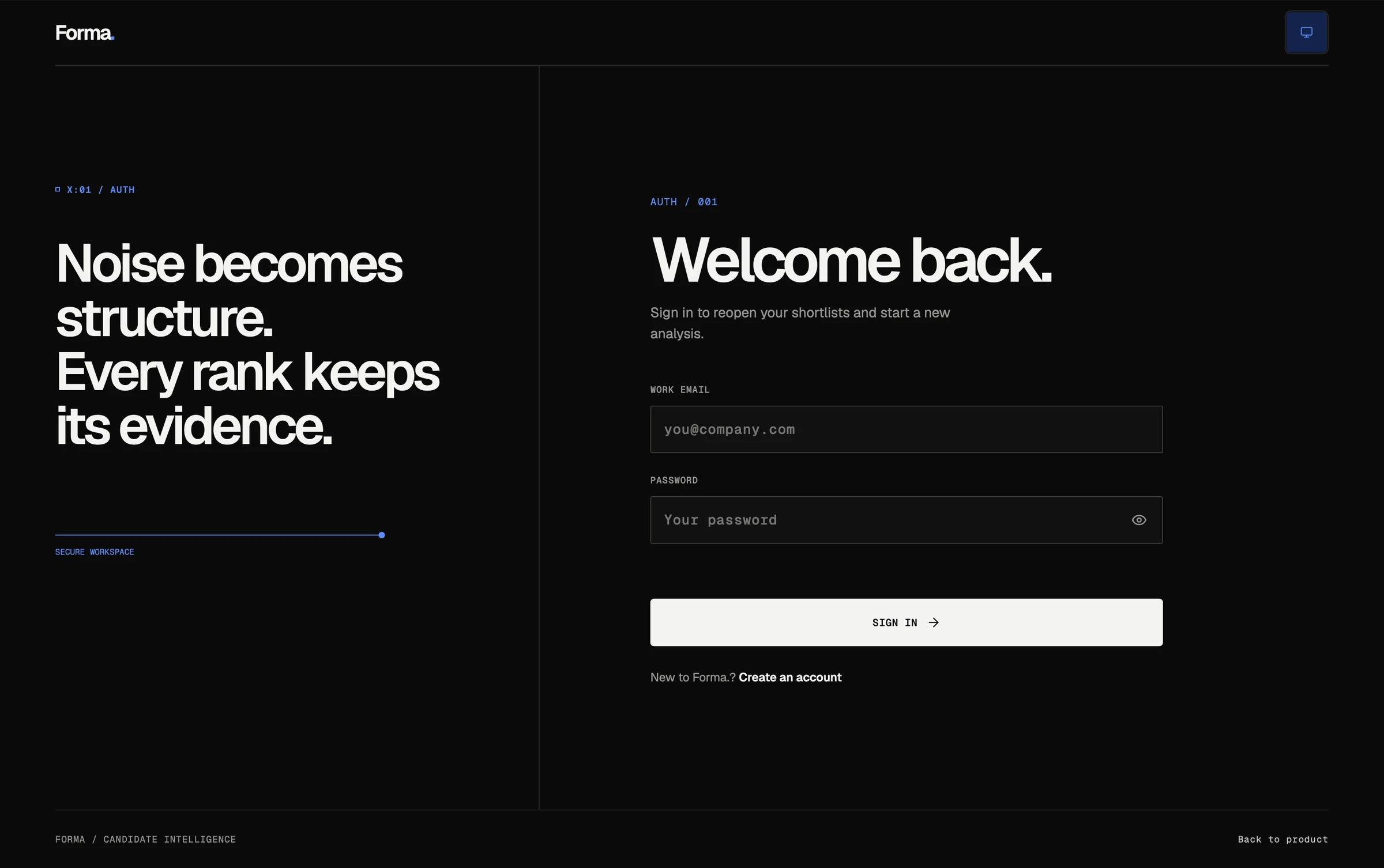
A workspace to return to.
The welcome-back screen connects authentication to the product’s ongoing work: reopening shortlists and starting another analysis. The supplied screens show the public product, scoring method and sign-in experience.
A complete candidate-intelligence product, with an inspectable scoring method at its centre.
I built the full-stack product and integrated AI-assisted analysis, semantic search and authentication around a transparent candidate-scoring method.
Explore the live project — Forma. (opens in a new tab)